In the run-up to the Union Budget, expected to be presented on July 10, this paints a grim picture for Finance Minister Arun Jaitley.

Politically, it will not be easy for Modi to take hard decisions such as raising fuel prices in the first budget, given the risk of higher inflation.

An article on 'State of the Economy' in the monthly Bulletin also said the improvement in the outlook for agriculture and the revival of rural spending have turned out to be the bright spots in the evolution of demand conditions. Consumer price inflation ticked up in June 2024 after three consecutive months of moderation as a broad flare-up in vegetable prices halted the overall disinflation that had been underway, it said.

Automobile (auto) retail sales in India grew by an impressive 14 per cent in July compared to the same period last year, driven by a surge in the rural economy, good product availability, and product launches. While passenger vehicles (PVs) saw a 10 per cent increase during this period, inventory levels have surged to a historic high of 67-72 days in PVs, equating to Rs 73,000 crore worth of stock, according to the Federation of Automobile Dealers Associations (Fada). This poses a risk to dealer sustainability. Inventory levels in July 2023 were only 50-55 days, equating to a stock worth Rs 49,833 crore. In June 2024, inventory was between 62 and 67 days, with a stock value of Rs 60,000 crore.

The government has spent a little less than one-third of the Budget estimate of capital expenditure, it can still spend about Rs 20,000 crore this year without disturbing its fiscal deficit target.

The fiscal deficit in the first five months of the current fiscal ended August stood at Rs 3.69 lakh crore, or 66.5 per cent, of Budget estimates for 2015-16.

The wide current account deficit is structural in nature and only structural responses will work, says Subir Gokarn.

Guvt plans to bring down the fiscal deficit to 4.8 per cent in the next fiscal, 4.2 per cent in 2014-15, 3.6 per cent in 2015-16 and to three per cent in 2016-17.
India's fiscal deficit is projected to more than double to 6 per cent of GDP this fiscal against the budgetary target of 2.5 per cent. For the next fiscal, the deficit is estimated to be 5.5 per cent of GDP.

In the Financial year 2013-14 there were encouraging signs on the foreign trade front as India's trade deficit recorded a sharp fall.

By taking the mutual fund route, investors can take exposure to gilts with small amounts. Over a decade or more, returns from these funds tend to be sound.

Retail inflation crossed the RBI's comfort level and rose to 5.21 per cent in December on increase in prices of food items.

The deficit for April-June was at $21.8 billion or 4.9 per cent of GDP.

The most pressing issue facing the financial sector is the rising stock of non-performing assets in the banking system

The situation raises concerns about whether the promised freebies will once again push the state into a revenue deficit.

The government has exhausted only 39 per cent of its fiscal deficit target in the first half of FY24.

The fiscal deficit, gap between expenditure and revenue.

India can sustain 8 per cent annual GDP growth and the conducive macroeconomic configuration may become a launching pad for a step-up in the country's growth trajectory, said an article on the 'State of Economy' in the central bank's March Bulletin published on Tuesday. Over the period 2021-24, gross domestic product (GDP) growth has averaged above 8 per cent. The global economy is losing steam, with growth slowing in some of the most resilient economies and high frequency indicators, pointing to further levelling in the period ahead, said the article authored by a team led by RBI Deputy Governor Michael Debabrata Patra.
Fiscal deficit, which was reined in during 2003-04, was relatively higher at Rs 25,998 crore (Rs 259.98 billion) in the first month of the new financial year.
The fiscal deficit for 2015-16 may eventually come down to the targeted level of 3.9 per cent of GDP.

In comparison, the central government's fiscal deficit stood at Rs 3.06 lakh crore (Rs 3.06 trillion) in the corresponding period of the previous financial year.

The higher salaries and pension outgo will be equivalent to about one per cent of the GDP.
Under the Fiscal Responsibility and Budget Management Act, the Centre should have eliminated the revenue deficit and brought down the fiscal deficit to 3 per cent of gross domestic product by March 2008. This target was extended by a year. Then, due to the global economic crisis, the government decided to suspend implementation of the FRBMA. As a result, the fiscal deficit for 2008-09 crossed 6 per cent of GDP and is projected at 5.5 per cent in fiscal 2009-10.
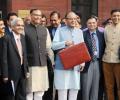
The fiscal deficit in current fiscal has been estimated at 3.9%.
The biggest challenge was the large government borrowings that are likely next year to finance the government's fiscal deficit, bankers said at the Business Standard Banking Round Table in Mumbai on Tuesday. According to initial estimates put out by the government, the fiscal deficit will be 5.5 per cent of gross domestic product.

In absolute terms, fiscal deficit, or the gap between overall expenditure and receipts, stood at Rs 74,611 crore (Rs 746.11 billion) in the first month of the current fiscal, against Rs 53,993 crore (Rs 539.93 billion) in the same period last financial year (2010-11).

The Economic Survey today pegged the fiscal deficit for 2010-11 at 4.8 per cent, lower than the Budgetary estimates of 5.5 per cent, on the back of higher realisation from 3G spectrum auction and buoyancy in revenues.

What stood out in his 15-year journey as a member of the political executive at the Centre was his glowing record as India's most successful and effective finance minister. Both as prime minister and finance minister, he understood the importance of gradualism, except when the economy or the polity was in a crisis.
Besides, India would meet over half of its proposed expenditure for the next fiscal with its billionaires' wealth, while the American billionaires' total wealth would meet only one-third of their country's proposed $3 trillion expenditure in the next financial year.

Finance Minister Nirmala Sitharaman on Thursday announced a Rs 11.11 lakh crore spending on infrastructure and vowed to continue reforms as she resisted resorting to populist measures in Modi government's last Budget before general elections, instead choosing to stay on the path of cutting deficit while bolstering measures for focus groups.
In a rare feat, the Centre has managed to bring down fiscal deficit marginally to Rs 83,843 crore (Rs 838.43 billion) during the first six months of this financial year from Rs 86,328 crore (Rs 863.28 billion) till August.

The liquidity in the banking system moved into surplus almost after three months as the Reserve Bank of India (RBI) absorbed over Rs 40,000 crore from the market on Monday, predominantly on the back of increased government spending. However, this situation may be short-lived given the higher demand for funds to pay taxes and year-end targets, treasury executives said. Meanwhile, two variable reverse repo rate (VRRR) auctions held on Tuesday received weak response.
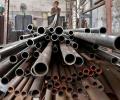
India's leading steel companies hope the Modi 3.0 Budget will continue the massive capital expenditure currently underway, focusing on infrastructure development, manufacturing, and fair trade. The infrastructure segment is the largest steel user, and the government's focus has fuelled steel consumption even as international markets have underperformed. According to provisional statistics, steel consumption grew 13.6 per cent in FY24, reaching 136 million tonnes (mt), according to a CRISIL report.

Alloting more funds for MNREGA and PM-KISAN could wipe out the entire additional money that the Centre may have for FY25.
The fiscal deficit was 4.9 per cent of GDP in 2012-13.

'In a serious fiscal situation like this, an ostrich-like focus on annual budgeting, event management and defensive rhetoric will only make matters worse,' warns Rathin Roy.

At a time when major economies have increased spending, India will have to do the same.

Former prime minister Manmohan Singh said India is poised to take advantage of globalisation and engage in trade to finance its imports through exports.

The state's revenue receipts might not afford various freebies announced by the parties, unless revenue deficit and hence fiscal deficit is widened.
